
Reading Warren County Property Tax Records
Warren County splits its property records into two jobs. The Commissioner of the Revenue sets real estate assessments. Assessments land at full fair market value each January 1. Billing is the Treasurer's side. The Treasurer tracks what was charged, paid, or left unpaid. The Treasurer's inquiry and payment history gives the answer. GIS and the assessment database work well for pinning down a parcel. Pull any bill figure from the Treasurer's record. Don't estimate it off a value field.
| Field | What It Shows | Where |
|---|---|---|
| Assessed value | County value set at full fair market value for the tax year | Commissioner of the Revenue |
| Owner and parcel | Assessment data compiled from recorded and public sources | Assessment / GIS |
| Tax bill | Amount billed for the account and tax period | Treasurer inquiry |
| Payment history | Posted payments and bill details | Treasurer inquiry |
| Land-use assessment | Qualifying land program and possible rollback exposure | Commissioner / Treasurer |
An assessment is a tax valuation, nothing more. A recorded sale can be useful evidence about value. Still, the county's assessment screen is not a private appraisal and no promise of a sale price. Warren County also cautions that timing can leave the online record a step behind the current taxable record. So use the assessment for tax roll questions. Use the Treasurer history for payment status.
Warren County’s Full-Value Assessment
Warren County says real estate is assessed at 100 percent of fair market value as of January 1. Virginia law provides the January 1 valuation and ownership frame. The annual tax responsibility can therefore reflect the owner and assessed value on that date even when a deed is recorded later in the year. A researcher comparing a new deed to the bill should keep the tax year and conveyance date side by side.
The county’s general reassessment follows a biennial odd-year cycle. The 2025 values became effective January 1, 2025, and the next reassessment is effective January 1, 2027. The assessment website is updated monthly for transfers, but this is separate from the broader reassessment cycle. A transfer update changes ownership data; a general reassessment changes assessed values on the county’s cycle.
The Warren County reassessment notice sets out the dates and review route.
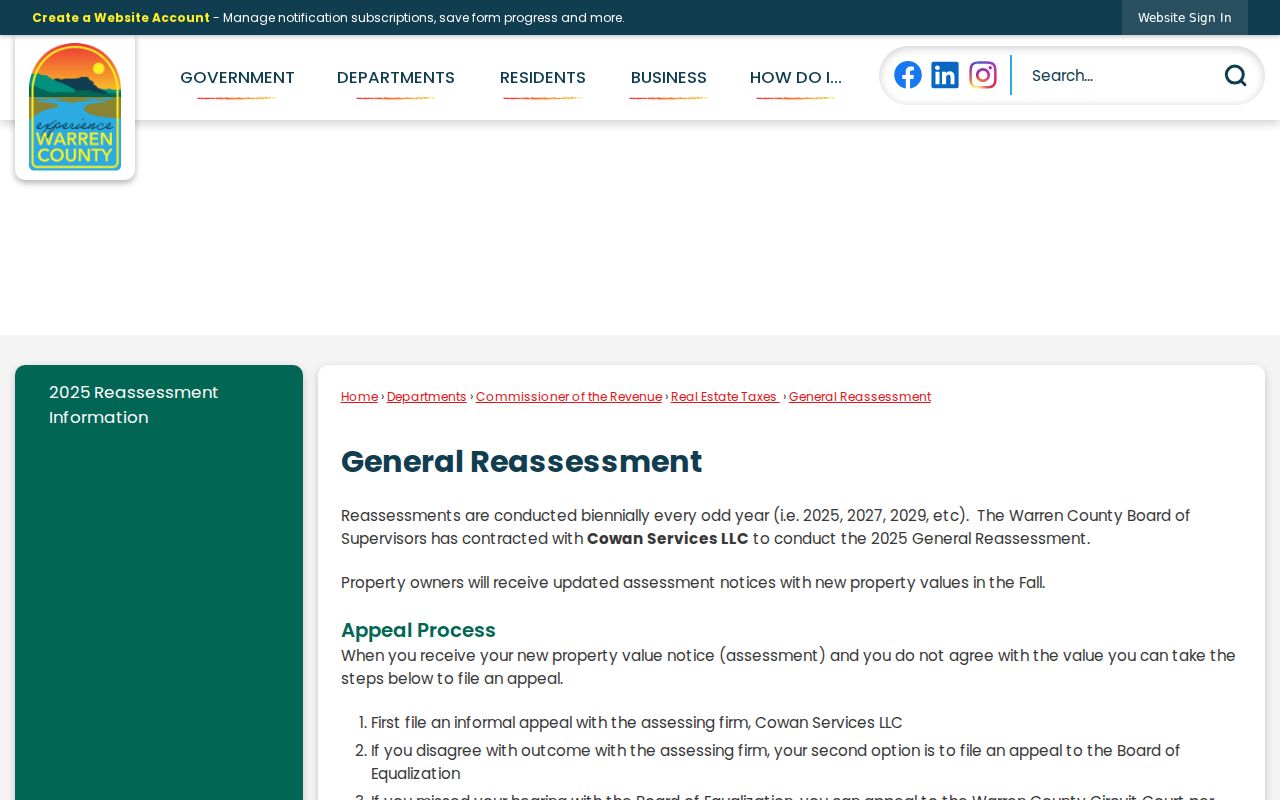
The county's reassessment page posts the full schedule and review route. It is the clearest way to tell the value cycle apart from the monthly transfer refresh.
Warren County Treasurer Search Options
The Treasurer's public real-estate inquiry takes several kinds of keys. A name search can start with three letters and return matching accounts. Parcel or GPIN, account number, and department or ticket details can narrow things further. The street search works without the house number. It may pull up a set of accounts along that road. If a query comes back too broad, pick the exact owner or parcel from the result list. The result flow moves through a name-selection screen, a payment-history screen, and a bill-detail screen. You can enter a projected date to calculate penalty and interest. Handy as those payment tools are, they say nothing about title changes. A recorded deed, mortgage release, or easement may have shifted the picture. Keep the parcel ID and account details with your bill question. The Treasurer's office can confirm account status. It takes payments online, in person, or by mail. For assessed value, the assessment portal remains the source.
Looking Up a Warren County Tax Bill
Start with an address or parcel identifier from GIS or the assessment side. Then pull the account through the Treasurer inquiry. It accepts owner name, account number, parcel number or GPIN, and street name. A name search may return several matching accounts, so confirm the situs and parcel before trusting the bill. Check payment history and bill detail separately. A current assessed value is not a balance due.
- Use the property address, parcel, GPIN, account number or owner name to locate the account.
- Choose the correct property if the name search returns multiple accounts.
- Review the bill detail and payment history for the tax period in question.
- Contact the Treasurer about delinquency or payment status that is not clear online.
- Assessed value
- The county’s tax valuation of real estate as of the assessment date.
- Tax bill
- The Treasurer’s charge for the account and tax period.
- Payment history
- Entries showing payment activity for the account.
- Rollback
- Additional tax consequences that can follow a land-use program disqualification.
June and December Warren County Payments
Warren County real-estate taxes come due in two halves: June 5 and December 5. The Treasurer takes payments online, in person, or by mail. The office sits at 220 N Commerce Avenue, Suite 800, in Front Royal. It lists its phone as 540-635-2215. County information notes that eCheck carries no convenience fee. Card payments add a 2.50 percent fee. The Treasurer's tax payment page posts the current channels and dates. For an older bill, rely on its own payment history. Do not assume a date on a current notice applied in earlier years. The inquiry's projected-date option can calculate penalty and interest. When a payment is pending or a balance is disputed, check with the office directly.
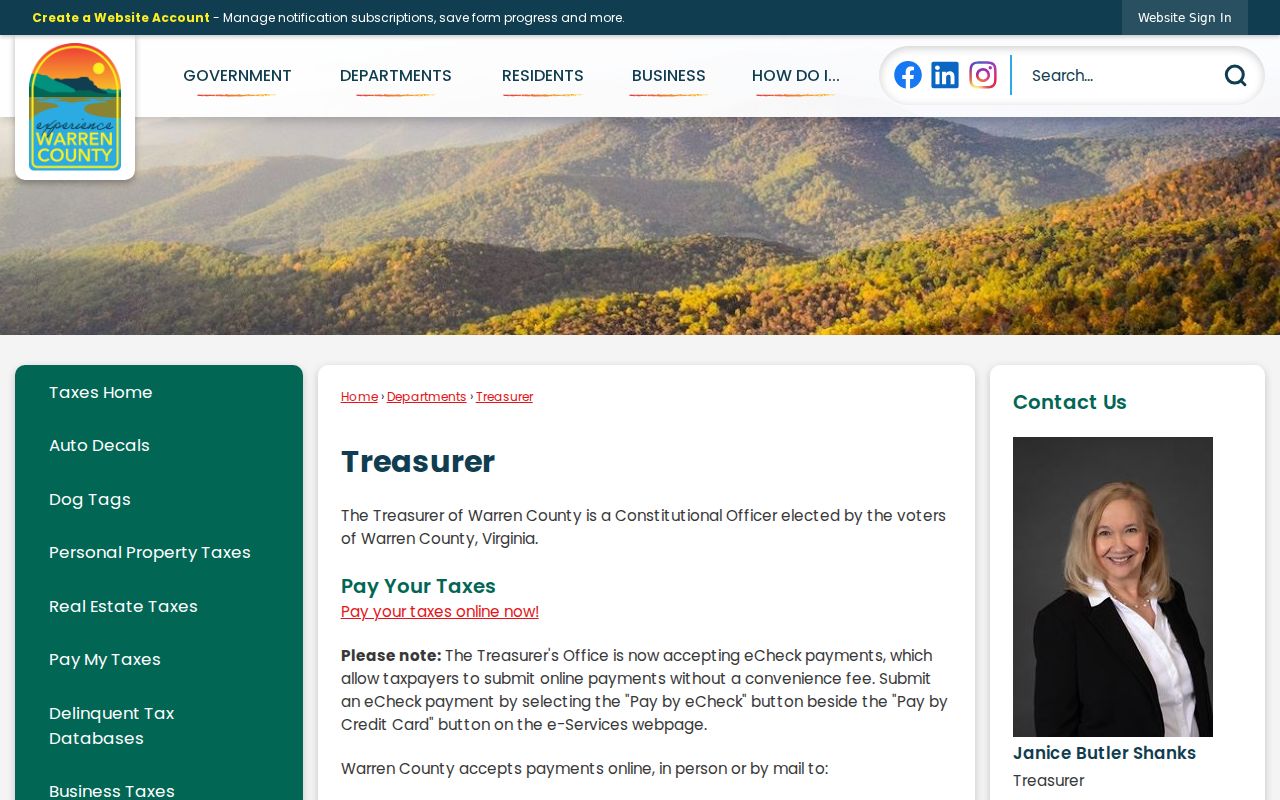
The official Treasurer page is the best place to confirm how and when to pay. The assessed value alone never reveals whether the bill is paid.
Land-Use Tax Treatment in Warren County
Warren County assesses some land under special use categories: agricultural, horticultural, forestal and open space. Qualifying parcels get a taxable value built on that use rather than full market value. That is the appeal for many owners. It is not automatic, though. A parcel must satisfy statutory and local conditions, and the program comes with strings.
Changing the use later can trigger rollback taxes or delinquency consequences. So never guess eligibility from acreage or a rural look. The county's land-use materials set the requirements and the application steps. When reviewing a tract, check whether the assessment record shows land-use treatment. Ask the Commissioner of the Revenue about its current status. A big rural holding may carry a classification that a simple map search never displays.
Read the pieces together. The Treasurer's tax bill tells you what was charged. The assessment record and the program file explain the valuation basis behind it. A status change can reach bills beyond the current year. So confirm details with the responsible office before you count on the numbers.
Warren County’s Monthly Transfer Refresh
Warren County updates its assessment records monthly, the county says. Even so, the online owner field can trail a newly recorded deed. The county itself warns that its display may not reflect the current taxable record. So a lag means little on its own. It does not establish an exact turnaround for any individual sale.
When a transfer is recent, line up three things: the assessment date, the latest recorded deed, and the January 1 rule for the tax year. A deed can be recorded this year while the tax roll still shows the January 1 owner of record. The questions pull in different directions. Who received title? Answer that from the recorded deed. Whose account is the bill on? Answer that from the Treasurer's tax bill detail.
The county assessment page links the database and posts its current-record warning.
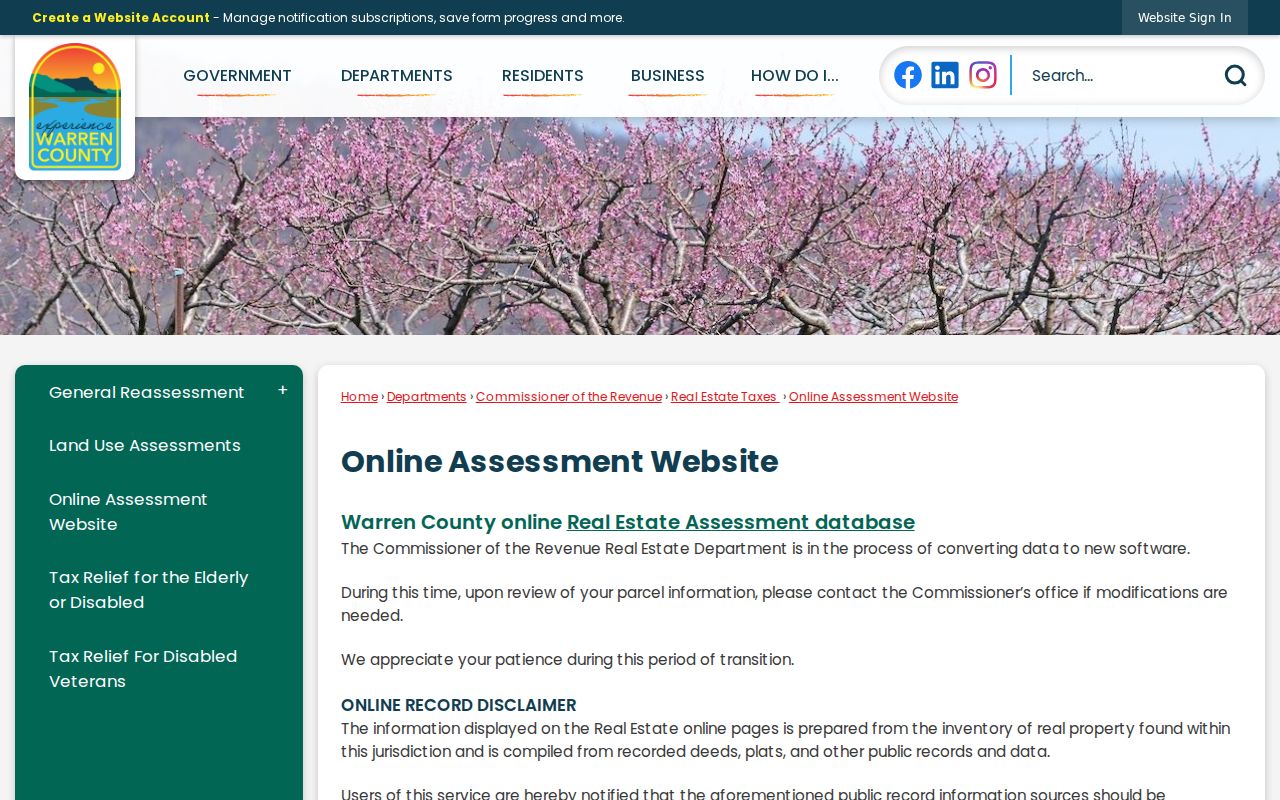
The assessment notice is worth a second look when timing matters. Compare the displayed tax record against the underlying deed before drawing a conclusion about ownership.
Reviewing a Warren County Assessment
Warren County lays out a clear sequence for assessment review. A value concern starts with the Commissioner of the Revenue. It then moves to the Board of Equalization. From there it can be appealed to Circuit Court. The assessor's office is where to raise the issue first. There you can learn the applicable filing period and what evidence applies. One caution: do not assume a recent asking price alone proves the assessment wrong. Compare the parcel's characteristics against the county's actual valuation basis.
Good evidence takes several forms. Comparable sales, property condition, acreage, and improvements all matter. So does the legal description, which shows what land truly belongs to the parcel. Check that the GIS map and the assessment details describe the same tract. A lot split, a consolidation, or a land-use status can make a simple comparison misleading.
Review sequence. Begin with the Commissioner of the Revenue, then use the Board of Equalization route described by the county; a further appeal proceeds to Circuit Court. Confirm the current filing dates and procedures directly with Warren County.
Appealing a Warren County Assessment
The published review route in Warren County runs in three steps. It begins with the Commissioner of the Revenue. It continues to the Board of Equalization, and can proceed to Circuit Court. The county's general reassessment information explains this sequence. It directs taxpayers to the Commissioner for the current filing period and forms. One warning about timing. An appeal window is tied to the applicable assessment cycle. Never reuse a date from an earlier reassessment notice without confirming it still applies.
Build the case around the right parcel. Acreage, improvements, property condition, the legal description, land-use treatment, and comparable sales may all bear on the disputed valuation. Watch for mismatches first. If the GIS map, the assessment card, and a recorded subdivision describe different parcel shapes, resolve that before comparing values. Keep the frame straight, too. This is an administrative review of the assessment. It is not a deed correction and not a boundary survey.
Appeal window. Ask the Commissioner for the filing deadline and required form for the tax year in question. Confirm dates directly with Warren County before submitting evidence.